



T-Mack1
-
Posts
128 -
Joined
-
Last visited
-
Days Won
1
About T-Mack1

T-Mack1's Achievements






-
 Ok guys, while volunteering at the Mack Truck Historical Museum, I had chance to work on a steering column mounted Signal Stat turn signal module with the rare 11 wires. Since the internet doesn't show the wiring for them and the unit is obsolete, here is the wiring explained. Signal Stat (Sigflare) 900, 11 wire Standard wires (also on the on 6 & 7 wire units): Blue (if present) - Input for internal indicator light (from 3 prong style flasher module, "I" pin) Yellow - Input from flasher module (blinking on-off) Gray w/Black trace - Input from Brake switch Green - to Left front turn signal light Red - To Right front turn signal light Gray - to Left rear Turn/Brake light Black - To Right rear turn/brake light The 4 wires extra wires Red w/Black trace - feeds power to front turn lights filaments when turn lever/4-Way is not active (NC). Opens appropriate contact when lever actuated and connects it to flasher. (use ballast resistor to dim filaments for running/parking lights) White - Auxiliary Common (NC) White w/red trace - Auxiliary Right White w/green trace - Auxiliary Left Notes: 1) Aux connections are "Normally Closed" (3 white leads tied together). Lever actuation "opens" the appropriate wire/connection). (( I have no clue how this would be used.)) 2) If you have the blue wire, you need to use the correct flasher module that has the indicator output pin 3) Warning: on most Signal-Stat steering column mounted units, using the 4-way flasher slide bar, disconnects the brake lights. Keep that in mind if driving with someone following too closely. enjoy, Tom M.
-
- 1
-

-
The Nuss Collection
T-Mack1 replied to kscarbel2's topic in Antique and Classic Mack Trucks General Discussion
That's Bob Nuss, The owner of Nuss Trucks (Mack, Volvo dealership with multiple locations) and also the museum. -
The two things are called circuit breakers, and are available at most auto parts stores. Also on Amazon. Normal ratings are 10A, 20A, 30A and 40A. Some come as 6v and some 12v. You can get some other amp ratings but might be harder to find. They are also called thermal circuit breakers as they reset when they cool down. They can go bad. Arching as they open up can eat away at the contacts. Also, as said above, those corroded wires will cause an extra load on the circuit too. Hopefully the corrosion doesn't go too far back into the wires, so that you can trim them shorter and add a new connector. Although the one wire looks pretty short already.
-
I will when I get back down to the truck. It's at my brother house. But, I'm not so sure it would be much help as it's a Firetruck which means a Gasser engine ENF707C (in 1957 they took less time to warm up and get moving). Yes, it's a Thermodyne but that just means it sort of shares some features that a diesel has. Similar block. The Compressor is in the same spot, but in place of the diesel fuel pump, we have ignition distributors (two since it's a firetruck).
-
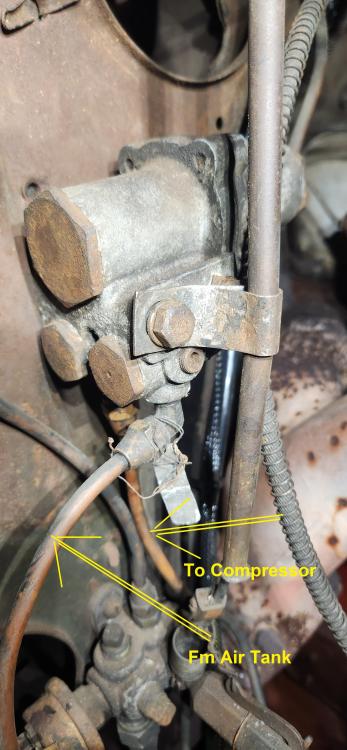
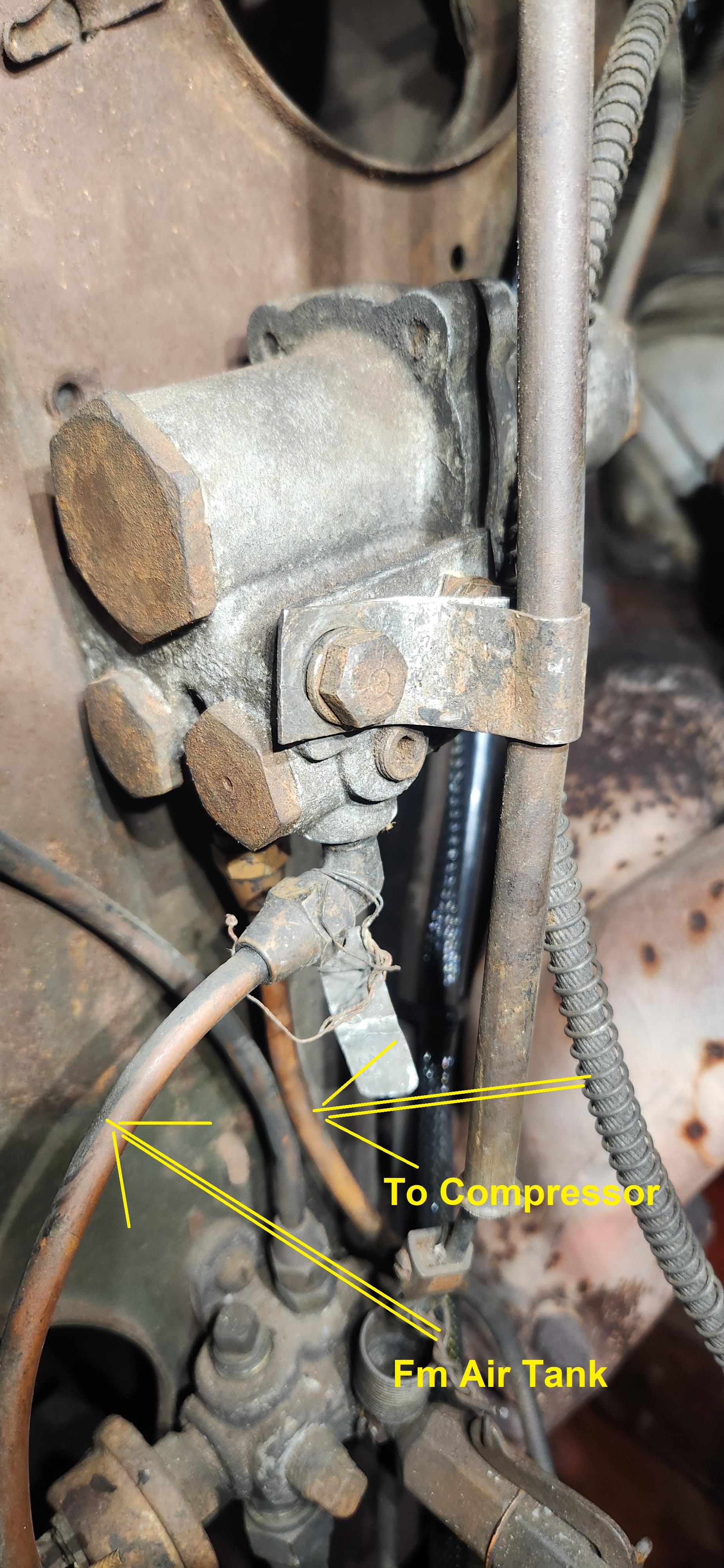
Here's a Picture of our compressor "Unloader" (AKA the governor). It is working and has a range, where it turns off the compressor at 120 psig, and restarts it around 85 psig. Note: before starting the truck we sprayed some PB-Blaster in all the ports.
-
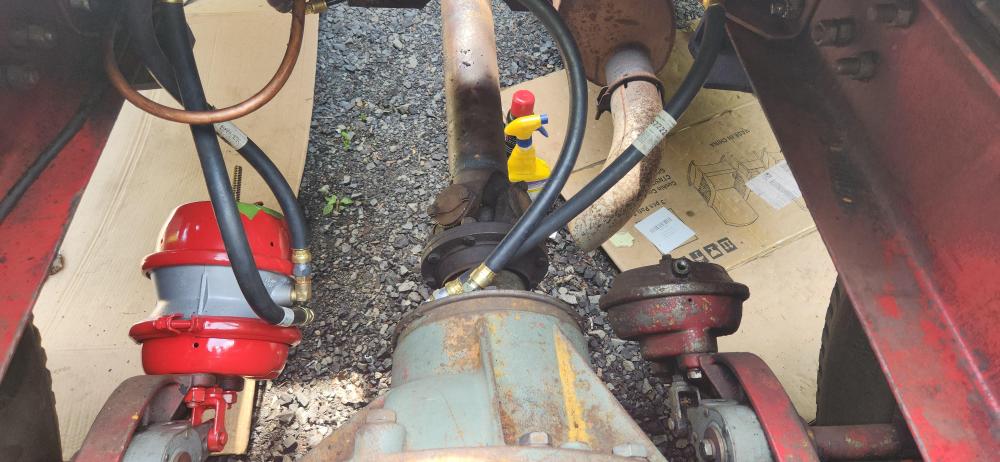
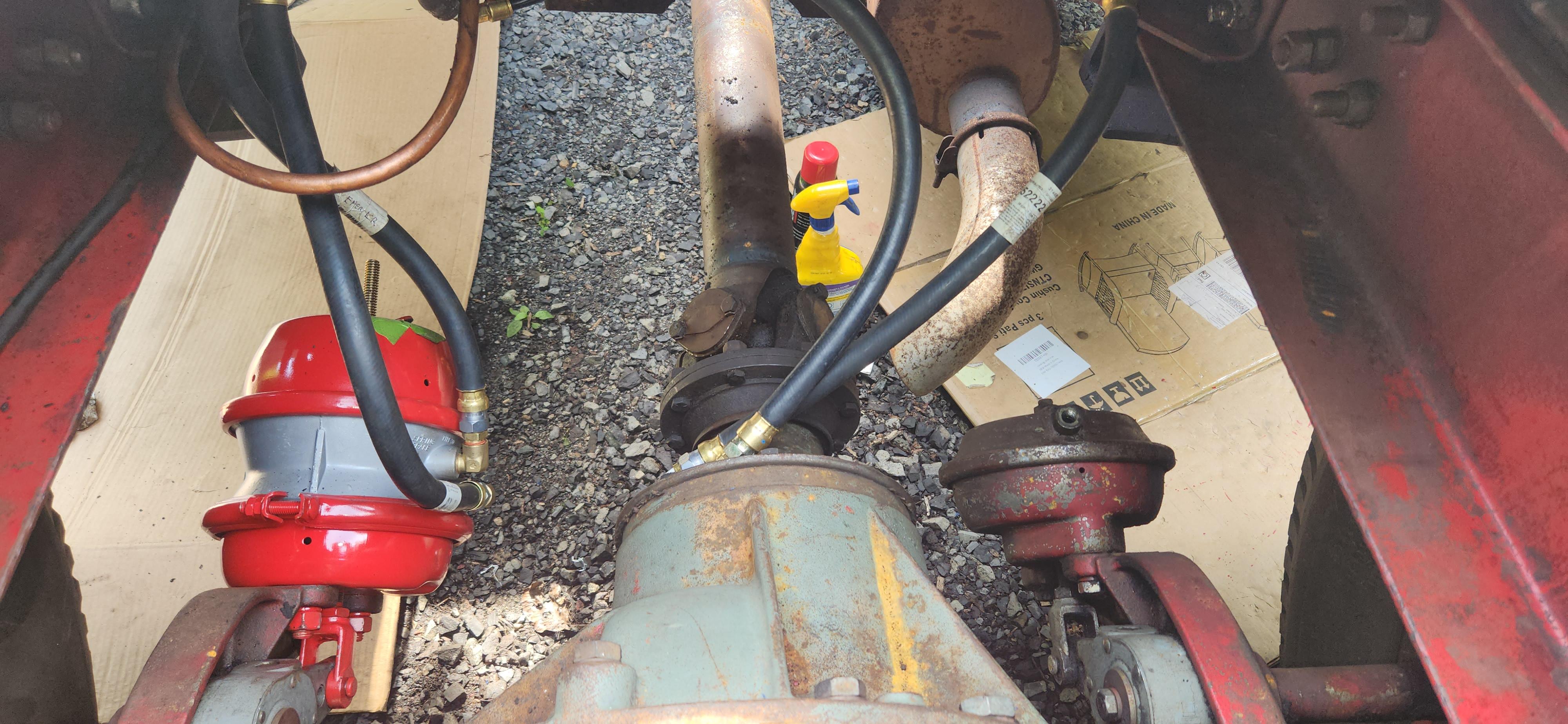
Attached picture is when we converted to Spring brakes. Left side is new dual chamber spring brakes, right side has the single chamber "service only" chamber. Conversion requires a quick release valve (QRV) and a park brake valve (& knob on dash), plus plumbing work. We used plastic pipe (synflex). Next, the way the forum is setup, you only get so many bytes of upload for free. I spend the $75 to get unlimited upload. Makes showing/helping others easier. It also helps if you are asking for help and want to show a picture.
-
Nice find. Your compressor unloader (also called a governor) looks like the one that is on our '57. It's the thing on the right side of first picture (horizontal cylinder). We don't have an air dryer (wet tank only), so ours only has 2 lines. Bigger line from air tanks, and 1/4" line down to compressor to "unload"/turn off it off when pressure is reached. If you need a picture, let me know. I'm not sure what the other two things are in the picture. We have a low pressure alarm switch in that area but it looks different. Next, I see you have a drive-line parking brake (brake lever in cab). Do you have "service only" on the rear or did someone convert it to Spring brakes? Ours was service only but we converted to spring brakes.
-
Yep, Mack made boat engines. And stuff for railroads, but that was mostly small tugs.
-
Mack AC Cylinder Removal
T-Mack1 replied to Great White's topic in Antique and Classic Mack Trucks General Discussion
Glad to hear you got them off. The sweet feeling of success is a great thing!!!!! -
Mack AC Cylinder Removal
T-Mack1 replied to Great White's topic in Antique and Classic Mack Trucks General Discussion
Have you tried to apply heat to the engine block to expand the metal? And, heat cycling where you use a penetrating oil to cool it back down may help. DO NOT hammer on it. The metal could be brittle with age. -
Online auction is active. https://tomhallauctions.hibid.com/catalog/706752/01-20-2026-mack-truck--primitives--beer-items--plus-
-
Like said above, driving it down the road verse trailering changes stuff. And ours, a firetruck (from a major city to boot) adds to the decisions. Safety becomes an issue if driving down the road. We changed our "Service Only" brake chambers on our '57 B85F to have spring brake chambers on the rear. We are planning to drive the grand kids around and that was a no brainer. Yes, very visible and had to add the yellow knob on the dash. The QRV is hidden under the firetruck "turntable" ( the equivalent of a fifth wheel but is for a permanent mount fire trailer (Hook & Ladder)). The firetruck dual starter buttons , the two separate battery systems and the run the ignition off "Battery A or B" switch is a discussion Jack and I have repeatedly. I'm leaning towards keeping it, but battery technology today verse 1957 makes it almost not needed, especially on a truck that's no longer on emergency response duty. So, keep it because it's sort of neat, or get rid of it (or not use the buttons but leave them in place) because it's not needed....?? Paint..... On a working truck, unless it has Historical value (like a UPS truck, or the Bethlehem Steel truck at the Museum), it's a new owner choice. That includes doing one of those patina looks. On ours, as a firetruck, a previous owner (Mr. Barton from East Hampton, CT) repainted the truck and put his own lettering on it. "Barton" on the hood, and "Ladder 1" over "East Hampton" on the doors. It originally had "Boston" "Fire Department" on the hood, and "Ladder 11" on the doors. After a bunch of talking, where I really wanted it back to the Boston Scheme, verse a "Mack Family" scheme, I think we are headed to the Boston scheme. More Historic, and a conversation starter. There is a thought to have a list of owners somewhere but that is far from important at this time. Trolley valve...... the trailer is long gone, so it does nothing (lines are plugged). Jack is leaning on getting rid it. My plan is to convert it to a type of manual Hill-Start (Mack "Grade Gripper"). Our treadle is a single circuit type, so easier to work on. I picked up a double check valve at the Mack Museum garage sale this past October. It has 2 inputs, 1 output. where one input shuts off the other. This will prevent the Trolley valve from venting thru the not pressed brake treadle and venting air and, vice-a-verse, when using the brake pedal, air venting out the trolley valve vent. That's going to be a hidden upgrade, so not many people would understand it's there. Note, I also picked up a modern 2 circuit treadle and a governor (compressor un-loader) at the garage sale, both NOS. Converting to Primary and Secondary air....... talk about a lot of work. Good work, but very tedious. Then there's the wiring. Restore to original functions or make it more modern. It's mostly hidden so only some people will notice. For ours, Doug Maney, the curator of the Mack Historical Museum, said to me "Tom, you will find that firefighters think they are electricians, but they are not". Need I say more. In the rewiring, I keep wanting to make it more modern (the electronic tech in me) , using more relays to shut things off when the key is turned off (yes, adding a key is another upgrade for a firetruck). Jack, the Master Electrician, wants to keep it simple and that means more original. Wheels, Update or keep original. That's more on how much you want to spend. Shiny Aluminum, modern size rims, etc etc. We have 11.00-20 tires on the 3 piece Budd rims (sliding ring (bead ring) that hold the split lock ring in place). The price of 20 inch truck tires is rather high now a days, because they are now custom ordered at most places. So we are converting to 22.5 inch Budd rims. Wanted the "Five opening" rims, but they are hard to find. Picked up 6 Accuride "Two opening" rims at a great price. But now I have a lead on 4 "five opening" ones, and if we get them, 4 of the two opening rims will be available. We now got tires for the rims. Just a matter of sanding and painting the rims. Dream: add a second row of seating for the grandkids. That will be a very noticeable modification. But, depending if a lead on another "open cab" cab pans out , it could look awesome and raise the value. And I would like to make it a bolt on addition, so it could go back to a Tractor-Drawn-Aerial-Ladder if someone "gives" us a tiller trailer and a free space to store it. So........ the decision seems to be a Concourse Trailer Queen or a Driver. We're going for the "driver" restoration.
-
Not sure, but looks like on-line auction starts at 7PM EST on 1-20-2026 https://tomhallauctions.com/auction/griswold-neer-werk-pol/
-
I looked at the Auction House's website and a date & location hasn't been posted yet. https://tomhallauctions.com/
-
Not sure, but if they both don't work at the same time, I would think it might be a dash power supply or ground issue. Ignition switch or fuse could also be suspect....


BMT Forum Logo